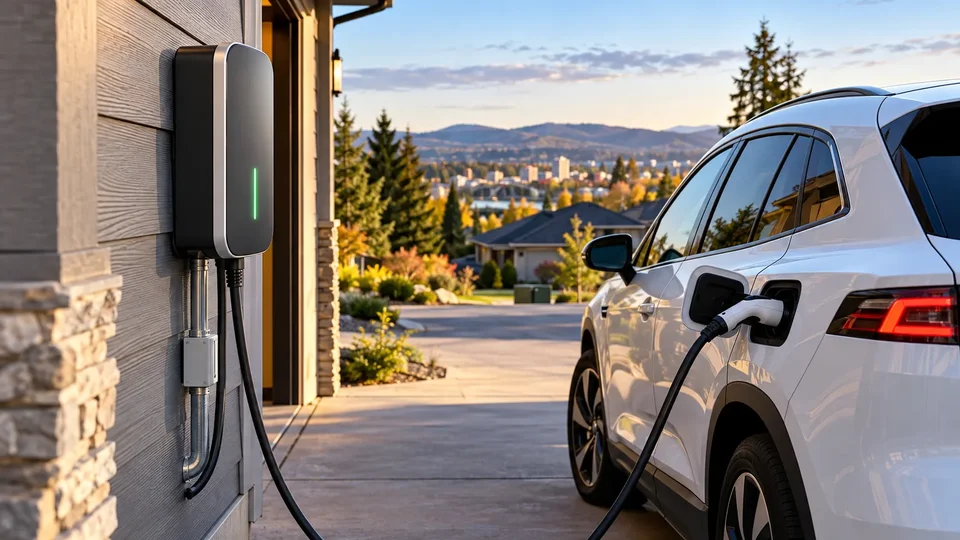
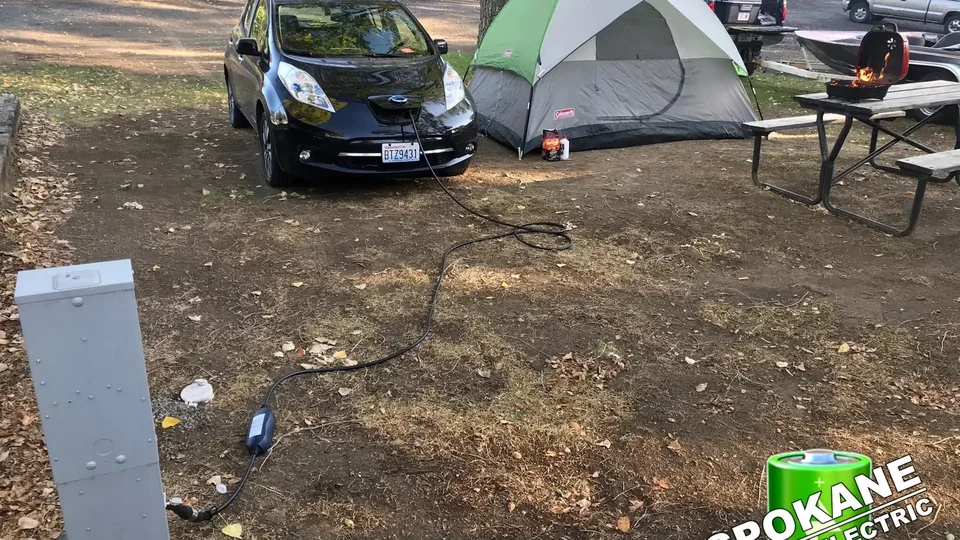
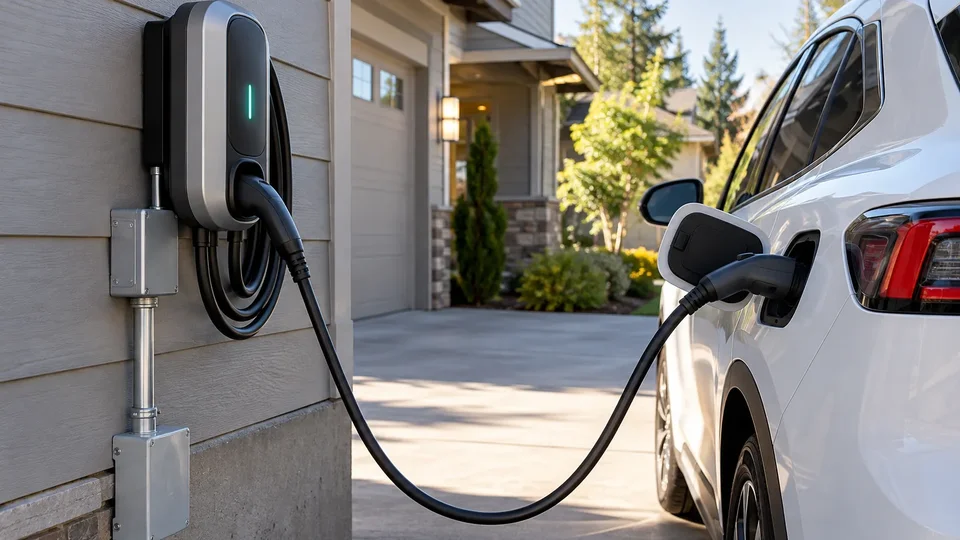
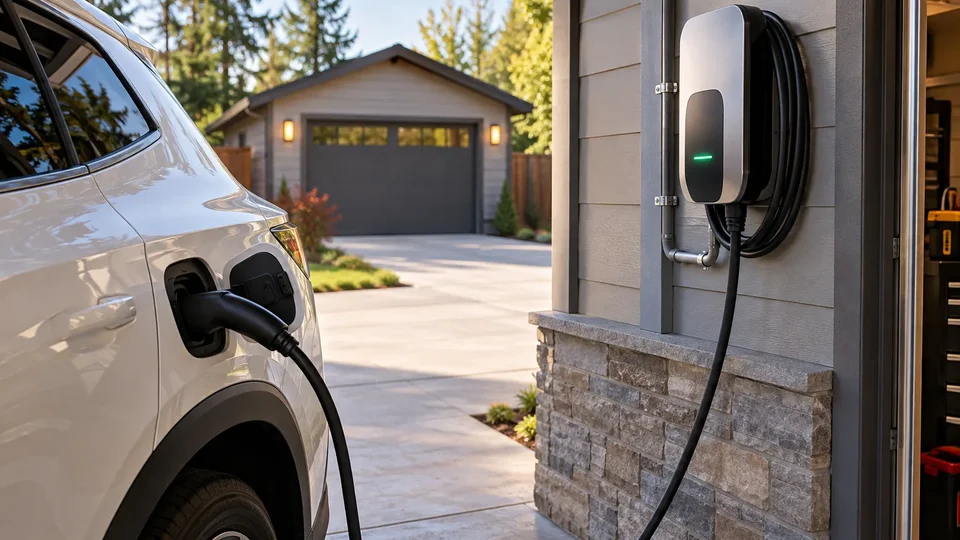
Power your electric vehicle with 100% clean Inland Northwest sunshine. Our licensed Washington (01) electrical contractors design and install integrated rooftop solar PV, smart solar-diverting Level 2 chargers, and battery storage systems operating seamlessly under Avista net metering.
Get upfront pricing, solar array sizing, and utility net metering calculations for Spokane County homes.
Spokane receives an impressive 174 sunny days per year and averages between 4.2 and 4.8 peak sun hours daily from late spring through autumn. Converting rooftop sunshine into vehicle fuel brings your equivalent cost of driving down to under $0.60 per gallon.
When you charge an electric vehicle directly from standard grid electricity in Spokane, you pay Avista Utilities approximately $0.11 to $0.13 per kilowatt-hour under standard residential electric tariffs. While this is already vastly cheaper than fueling an internal combustion vehicle, integrating a dedicated rooftop solar PV array locks in your fuel costs at roughly $0.04 to $0.05 per kWh levelized over 25 years.
By pairing your solar system with an intelligent Level 2 EV charging station, you capture clean solar energy during peak midday generation hours, minimize costly demand spikes, and eliminate your household's exposure to future utility electricity rate increases.
From straightforward grid-tied net metering to autonomous solar surplus diversion and off-grid battery microgrids, choose the architecture that matches your driving schedule and budget.
Your rooftop solar array operates grid-tied through Avista Utilities. During the day, surplus solar electricity is fed into the grid, turning your meter backwards and banking kilowatt-hour credits under Avista Schedule 62. At night, you plug in your vehicle and draw on your banked credits at a true 1:1 ratio.
We install specialized smart Level 2 EV chargers equipped with paired current transformer (CT) clamps on your main electrical panel. The charger continuously monitors your solar inverter output and throttles charging speed (between 6A and 48A) in real time to match exact solar surplus.
Your solar panels charge a whole-home lithium battery bank (such as Tesla Powerwall 3, Enphase IQ Battery, or FranklinWH) during the day. The battery stores the clean solar energy to power your home and charge your EV after dark, with full automatic backup capability during utility grid blackouts.
Traditional EV chargers operate at a fixed, inflexible amperage (such as 32A or 48A). If your rooftop solar array is only producing 16 amps of surplus power on a partly cloudy Spokane afternoon, a standard charger will forcefully pull the remaining 16 to 32 amps directly from the Avista power grid.
Solar-aware smart chargers solve this by actively communicating with your electrical panel. If a cloud passes over the South Hill, the EVSE automatically steps down charging current to preserve 100% solar purity. When the sun bursts through, it ramps back up to full charging velocity.
Electric vehicle efficiency is measured in miles per kilowatt-hour (typically 3.0 to 3.8 mi/kWh). Here is exactly how much solar generating capacity is needed based on your annual driving habits in Greater Spokane.
| Annual Mileage | Daily Commute | Annual EV Energy | Recommended Solar Capacity | Typical Panel Count (400W) | Summer Surplus Yield | Winter Monthly Yield |
|---|---|---|---|---|---|---|
| 8,000 Miles/Yr | ~22 Miles/Day | 2,400 kWh | 2.4 kW DC | 6 Panels | +320 kWh / mo | ~85 kWh / mo |
| 12,000 Miles/Yr (Average) | ~33 Miles/Day | 3,600 kWh | 3.6 kW DC | 9 Panels | +480 kWh / mo | ~130 kWh / mo |
| 15,000 Miles/Yr | ~41 Miles/Day | 4,500 kWh | 4.8 kW DC | 12 Panels | +640 kWh / mo | ~170 kWh / mo |
| 20,000+ Miles/Yr (Dual EVs) | ~55+ Miles/Day | 6,500 kWh | 6.4 kW DC | 16 Panels | +860 kWh / mo | ~230 kWh / mo |
In Spokane's microclimate, each kilowatt (kW) of properly orientated rooftop solar PV generates approximately 1,250 to 1,350 kilowatt-hours (kWh) of clean alternating current electricity per year. Because modern electric vehicles consume between 28 and 34 kWh per 100 miles traveled, calculating your solar array requirement is an exact electrical engineering formula.
When sizing an array addition specifically for an electric vehicle, our licensed electricians factor in inverter clipping limits, temperature coefficients during 90Β°F+ Spokane summer heat waves, and winter overcast deratings to guarantee your system produces enough excess credits to keep your car 100% solar powered year-round.
Many Spokane homeowners ask: "Can solar really power my electric car through freezing Spokane winters?" The answer is an emphatic yesβprovided your system is engineered for Eastern Washington weather.
During Spokane winters, shorter daylight hours, persistent overcast skies, and intermittent rooftop snowpack reduce solar PV output to approximately 15% to 25% of summer peaks. While direct winter generation is modest, your annual energy balance remains positive because Spokane's summers are intensely sunny, dry, and cool enough to ensure high photovoltaic efficiency.
Between May and September, a properly sized 8 kW to 10 kW rooftop solar array generates two to three times more electricity than a typical household and vehicle consume combined. This surplus flows back into the Avista electrical grid as dollar-for-dollar kilowatt-hour credits. When December blizzards hit, you seamlessly draw upon your banked summer credits to heat and charge your vehicle.
Intelligent solar EV chargers transform your charging station into a responsive energy hub that coordinates with your inverter and main service panel.
Ultra-precise current transformer clamps installed on the main service feeders measure household electrical draw 10 times per second, ensuring zero exported solar goes to waste.
Unlike rigid on/off chargers, solar EVSE modulates output in 1-amp increments to match exact real-time solar surplus, preventing unintended grid power consumption.
Native software integration with Enphase Envoy, SolarEdge, Tesla Gateway, and SMA Sunny Boy provides live energy flow diagrams directly on your smartphone.
If you need a rapid full charge and solar is unavailable, intelligent scheduling commands the charger to pull from the grid only during Avista's lowest super-off-peak rate windows.
As licensed electrical contractors, we supply and install top-tier solar-aware EVSE brands including the Emporia Smart EV Charger (with Vue energy monitor), Wallbox Pulsar Plus (with Power Boost CTs), and Tesla Universal Wall Connector configured with Tesla Solar/Powerwall Charge on Solar mode.
Our master electricians handle the entire electrical scope: subpanel feeder installation, high-speed shielded communication cabling, sensor clamp calibration, and app commissioning to guarantee your system operates flawlessly on day one.
Inland Northwest windstorms, heavy ice, and wildfire season outages can leave neighborhoods without utility power for days. Pairing solar with battery storage ensures your electric car is always fully fueled.
Standard grid-tied solar systems are legally required to shut down during utility outages to prevent backfeeding power into downed lines where utility linemen are working. If the grid drops in Spokane, your solar panels shut offβunless you have an energy storage system with an automatic microgrid isolation switch.
When we install systems like the Tesla Powerwall 3 or Enphase IQ Battery 5P, your home instantly disconnects from the damaged grid during a storm. Your solar panels continue producing full power, charging your stationary battery while simultaneously supplying clean 240V electricity to charge your EV.
Washington State and federal clean energy laws offer substantial financial incentives that dramatically reduce the net installation cost of your solar-plus-EV infrastructure.
An uncapped 30% federal tax credit directly offsets the complete cost of your rooftop solar PV array, inverters, racking, battery storage systems, and associated electrical labor.
Under Washington law (RCW 82.08.962), qualifying residential solar installations and battery storage are 100% exempt from state and local retail sales tax.
Qualifying residential installations in eligible Spokane County non-urban or low-income census tracts can claim a 30% federal tax credit (up to $1,000) on EV charging hardware and electrical wiring.
From initial solar irradiance modeling and Avista interconnection filings to physical installation and official Green Tag sign-off, our master electricians manage every single detail.
We analyze your historical Avista utility bills, evaluate roof azimuth and pitch, inspect electrical panel ampacity, and calculate your vehicle's annual kWh demand.
We draft comprehensive single-line electrical schematics, NEC 220 load calculations, and structural roof mounting plans tailored for Spokane snow loads.
We submit all required Schedule 62 Net Metering applications and technical documentation directly to Avista Utilities for rapid interconnection approval.
Our licensed electricians mount roof racking, pull heavy-gauge copper conductors in EMT conduit, mount microinverters, and wire your dedicated 240V Level 2 charger.
We install energy monitoring CT clamps on your main service feeders, integrate the charger with your solar inverter, and configure dynamic solar-diverting software.
We coordinate official City of Spokane or County electrical safety inspection, obtain the Green Tag, and facilitate Avista bidirectional net meter swap for Permission to Operate (PTO).
The interconnection process with Avista Utilities requires precise engineering calculations under Washington State Administrative Code (WAC 480-108). Our team coordinates directly with Avista's regional distributed generation engineers to ensure seamless review, rapid meter change-outs, and zero administrative delays.
We guarantee every installation meets or exceeds National Electrical Code (NEC Article 690 for Solar PV and Article 625 for EVSE) alongside local City of Spokane building requirements.
Expert electrical answers to common questions about powering your electric vehicle with rooftop solar panels, Avista net metering, and battery storage in Spokane.
π Speak with a Master Electrician