⚡ WASHINGTON (01) CERTIFIED TESLA CHARGING CONTRACTOR

Tesla Charger Installation Spokane, WA

Dedicated 48A / 240V Wall Connector and Universal NACS charging solutions. Maximize charging speed up to 44 miles per hour, eliminate nuisance tripping, and unlock sub-zero winter preconditioning with precision electrical engineering.

  • ✓
    Max 48A Continuous Duty (11.5 kW): 40 to 44 miles of range added per hour.
  • ✓
    Gen 3 & Universal Wall Connector: Native NACS and integrated J1772 Magic Dock.
  • ✓
    Full Permitting Handled: Direct City of Spokane & WA Labor & Industries filings.
  • ✓
    Avista Rebate Assistance: Up to $1,000 in utility credits + RCW 82.08.816 tax exemption.
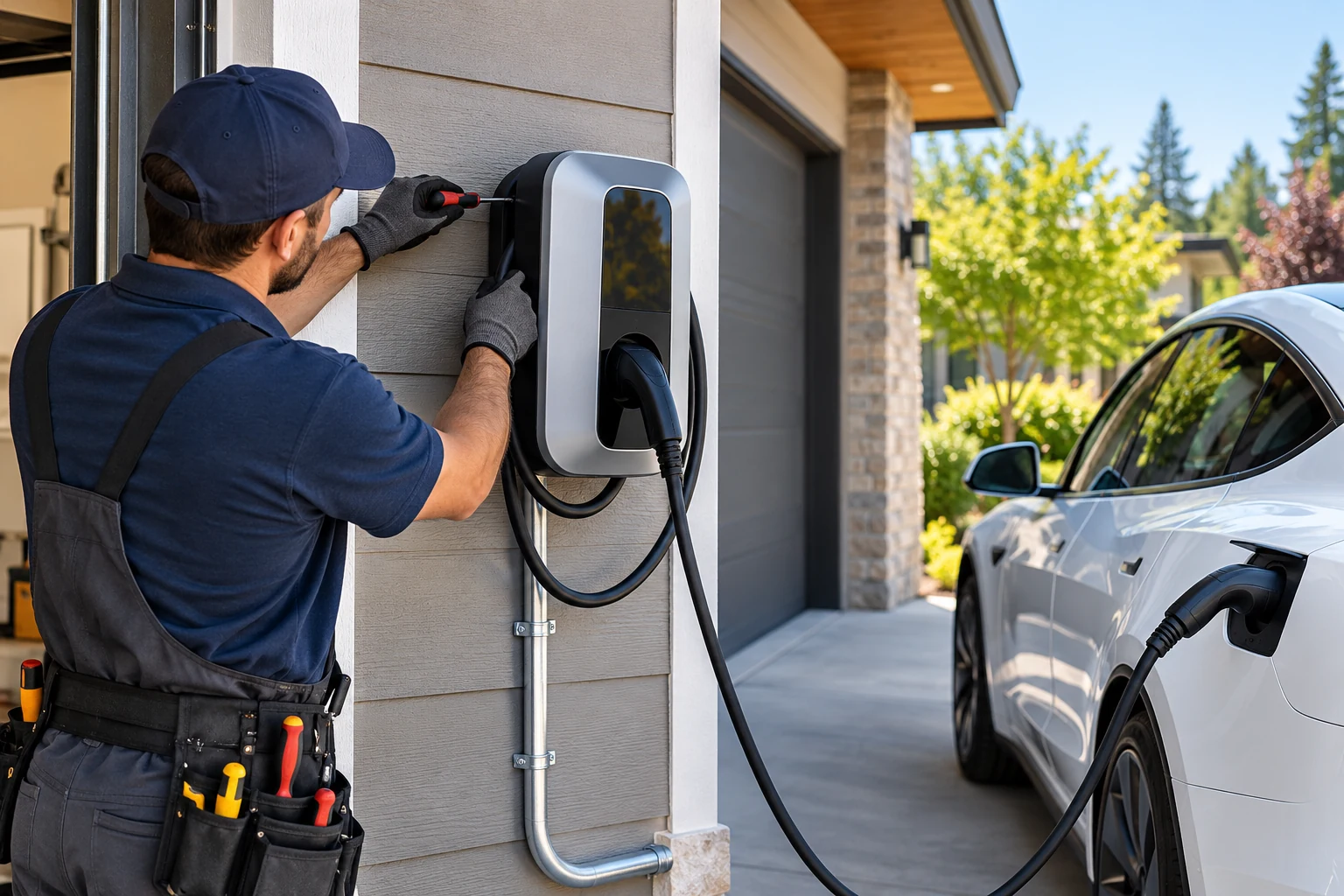
Certified electrician installing Tesla Wall Connector 48A charging station in Spokane WA
Avista Rebate Eligible · Up to $1,000 Off
Request Tesla Installation Quote
Direct response from a licensed Washington (01) electrical contractor.
WA (01) Electrical Contractor · Lic #EC-SPOKEV*821JA
Official City of Spokane & L&I Permits Included
Avista Schedule 77 Transportation Incentive Approved
5-Star Rated Spokane Tesla Charging Specialist

Professional Tesla Charger Installation Across Spokane, WA

Tesla electric vehicles—including the Model Y, Model 3, Model S, Model X, and Cybertruck—represent the overwhelming majority of electric vehicles traveling the highways of Eastern Washington. From climbing the scenic grades of the South Hill and cruising Interstate 90 into Spokane Valley to traveling north along Highway 2 toward Newport, Tesla vehicles deliver exceptional all-weather traction and instant electric torque. However, maximizing the daily convenience, battery health, and driving enjoyment of your Tesla requires a dedicated, permanent high-speed charging solution at your Spokane residence.

Attempting to charge a modern Tesla using the standard 120-volt Mobile Connector plugged into an ordinary household outlet is painfully slow. Adding a mere 2 to 4 miles of range per hour of charging means replenishing a depleted 75 kWh battery in a Model Y Long Range takes over four full days (50 to 60+ continuous hours). During freezing Inland Northwest winters, sub-freezing temperatures can halt 120V charging entirely because incoming power is diverted to heat the battery pack.

A dedicated Tesla Wall Connector installation permanently transforms your driving routine. Operating on a 240-volt dedicated circuit at up to 48 continuous amperes, the Tesla Wall Connector delivers 11.5 kilowatts of power, replenishing between 35 and 44 miles of driving range per hour of charging. You can return home in the evening with an empty battery, plug in with one hand, and wake up every morning to a completely replenished 100% battery pack.

Spokane electrical contractor mounting Tesla Gen 3 Wall Connector on dedicated 60A circuit
Precision wall mounting and conduit routing for a 48A continuous duty Tesla Wall Connector in Spokane.
Continuous Load Electrical Demands

Installing a Tesla Wall Connector requires certified electrical engineering. Drawing 48 amperes continuously for 4 to 8 hours represents the single largest electrical continuous load in modern residential construction.

The installation requires an accurate evaluation of your home’s electrical service panel, precise circuit breaker sizing, heavy-gauge copper conductors, calibrated terminal torquing, and full compliance with City of Spokane Municipal Code 17F.050.020 and Washington State Labor & Industries (L&I) electrical safety codes.

Precision Contractor Installation & Rebates

Our licensed, certified electricians specialize in dedicated Tesla and NACS charging infrastructure. We ensure surgical mounting precision, clean conduit bending, and lifetime operational safety.

From navigating the City of Spokane’s electrical permitting system to securing available utility rebates through Avista Utilities and state sales tax exemptions, local master electricians deliver seamless turn-key execution for every installation.

44 mph
Max Range Added Per Hour
11.5 kW
Continuous 48A Output
50 in-lbs
Calibrated Torque Specification
100%
Permitted & Code Compliant

Tesla Wall Connector vs. Mobile Connector vs. NEMA 14-50: The Great Debate

One of the most frequent debates among Spokane Tesla owners on local forums and owner groups is whether purchasing the dedicated Tesla Wall Connector ($450–$580 hardware cost) is necessary, or whether installing a 240-volt NEMA 14-50 outlet and using the Tesla Mobile Connector with a $35 plug adapter is sufficient.

While both options deliver 240-volt Level 2 charging, significant performance, financial, safety, and electrical code differences exist between the two approaches. The Tesla Mobile Connector was engineered primarily as a portable, travel-friendly emergency charger to be stowed in your vehicle's sub-trunk for road trips, RV parks, or remote destinations.

When used as a primary daily home charger, the Mobile Connector's internal electronics are hard-capped at 32 amperes (7.7 kW), whereas the Wall Connector delivers a full 48 amperes (11.5 kW)—charging your vehicle 50% faster. Furthermore, 2023 National Electrical Code mandates introduce hidden hardware expenses for 14-50 outlets that often eliminate the apparent hardware savings.

Tesla Wall Connector vs Mobile Connector vs NEMA 14-50 charging comparison for Spokane drivers
Hardwired Tesla Wall Connector vs plug-in Mobile Connector on a 240V NEMA 14-50 outlet.
Feature / Factor Tesla Wall Connector (Hardwired) Tesla Mobile Connector + NEMA 14-50 Detailed Engineering & Practical Analysis
Maximum Charging Current 48 Amps Continuous (11.5 kW) 32 Amps Continuous (7.7 kW) The Mobile Connector’s internal electronics are hard-capped at 32A. The Wall Connector charges 50% faster.
Miles Added Per Hour (Model Y) 40 to 44 miles per hour 25 to 30 miles per hour A full 0–100% charge takes ~5.5 hours on the Wall Connector vs ~9 hours on the Mobile Connector.
Circuit Breaker Required Standard 60A Double-Pole ($25 – $35) GFCI Double-Pole 50A Breaker ($120 – $180) 2023 NEC code strictly requires GFCI breakers for garage receptacles. Hardwired units bypass this cost.
Nuisance Tripping Risk Zero Risk High Risk Dual GFCI conflict: The Tesla Mobile Connector’s internal GFCI clashes with the upstream panel GFCI breaker, causing midnight shutoffs.
Receptacle Melting Hazard None (Permanently Hardwired) High Risk if using cheap outlet Standard builder-grade $10 outlets melt under continuous EV loads. Industrial Hubbell outlets cost $80–$120.
Cable Management & Convenience Permanent 24-ft cable neatly docked Cord must be unplugged and packed Leaves your Mobile Connector permanently stowed in your sub-trunk for road trips and emergencies.
Wi-Fi & Smart Features Built-in Wi-Fi, power sharing, diagnostics No Wi-Fi; basic pass-through only Wall Connector receives over-the-air firmware updates and supports dynamic multi-car power sharing.
The "Nuisance Tripping" Problem with NEMA 14-50 Outlets

Under the National Electrical Code adopted by Washington State, all 240-volt receptacles installed in residential garages and exterior locations must be protected by a Class A Ground Fault Circuit Interrupter (GFCI) circuit breaker. A dual-pole 50A GFCI breaker costs between $120 and $180.

However, Tesla charging equipment has ultra-sensitive, self-monitoring GFCI protection built directly into the charging handle and onboard electronics. When plugged into an outlet protected by an upstream GFCI breaker, the two monitoring systems continuously send micro-current pulses through the ground wire to test for faults. These pulses conflict, creating "phantom trips" that shut off the breaker at night.

Because a hardwired Tesla Wall Connector is permanently connected via continuous conduit, Washington electrical code does not require an upstream GFCI circuit breaker. The installation utilizes a standard $25 double-pole 60A breaker, eliminating nuisance tripping entirely while saving over $100 in hardware.

The Builder-Grade Outlet Melting Hazard

If a homeowner chooses a NEMA 14-50 plug-in setup, the quality of the wall receptacle is paramount. Standard hardware stores sell consumer-grade 14-50 receptacles manufactured by Leviton or Pass & Seymour for $10 to $15. These outlets are engineered for electric kitchen stoves and clothes dryers—appliances that cycle heating elements on and off intermittently for 20 to 45 minutes.

When a Tesla pulls a continuous 32 amperes for 8 continuous hours, the stamped-brass spring contacts inside cheap builder-grade outlets suffer thermal expansion, lose mechanical tension, and begin micro-arcing. Across Spokane County, electricians frequently replace charred, melted builder-grade outlets that have scorched garage walls.

If installing an outlet, licensed contractors strictly specify industrial-specification receptacles (such as the Hubbell HBL9450A or Bryant 9450FR) featuring heavy-duty glass-filled nylon housings and thick brass contacts designed for continuous thermal duty.

Gen 3 Wall Connector vs. Universal Wall Connector: Which Should You Choose?

Tesla currently manufactures two distinct residential Wall Connector models. Choosing the right version depends on your current vehicle and future household fleet plans.

Native NACS Standard
Tesla Gen 3 Wall Connector

The flagship charging station engineered exclusively for Tesla vehicles, delivering effortless one-touch plug ergonomics and sleek minimalist aesthetics.

Max Output: 48A / 11.5 kW (60A Breaker)
Cable Length: 24-Foot Lightweight Cord
Connector Tip: Native Tesla NACS Handle
Aesthetic: Tempered White Glass Faceplate
  • ✓
    Integrated RF Button: Pressing the handle button automatically pops open the Tesla charge port door.
  • ✓
    Ideal Application: Single-Tesla households or multi-vehicle families committed exclusively to Tesla vehicles.
  • ✓
    Hardware Cost: Typically $450 direct from Tesla or authorized electrical distributors.
Future-Proof Dual Standard
Tesla Universal Wall Connector

Celebrated by automotive engineers as the single best residential EVSE on the global market, featuring an ingenious integrated adapter that charges all EV makes.

Max Output: 48A / 11.5 kW (All EVs)
Cable Length: 24-Foot Premium Cable
Connector Tip: NACS + Integrated J1772 "Magic Dock"
Aesthetic: Dark Titanium Glass Faceplate
  • ✓
    Magic Dock Mechanism: Unlatches native NACS for Teslas, or unlatches with locked J1772 for Ford, Rivian, Hyundai, Chevy, BMW, VW.
  • ✓
    No Loose Adapters: Eliminates clumsy third-party plastic dongles rolling around garage floors.
  • ✓
    Ideal Application: Multi-EV households driving both a Tesla and another brand, or maximizing resale property value.
Over-the-Air Wi-Fi & Dynamic Power-Sharing Capabilities

Both the Gen 3 and Universal Wall Connector models incorporate integrated 2.4 GHz Wi-Fi transceivers that connect directly to your home wireless network. Tesla periodically pushes over-the-air firmware enhancements, adding new software capabilities, optimizing charging efficiency, and streaming diagnostic telemetry.

Furthermore, up to six Wall Connectors can be linked via local Wi-Fi mesh networking on a single electrical service. The chargers communicate dynamically in real time: if one Tesla is plugged in, it receives the full 48 amperes; when a second or third vehicle plugs in, the units automatically divide available circuit capacity (e.g., 24 amperes each). This prevents electrical service panel overloads without requiring expensive secondary panel installations or service utility upgrades.

Electrical Circuit Requirements & The 60-Amp Breaker Rule (NEC 625)

The foundational engineering principle governing Tesla Wall Connector wiring is National Electrical Code (NEC) Article 625: electric vehicle charging equipment is classified as a continuous electrical load.

Under NEC Section 625.42 and Section 210.20, overcurrent protection devices (circuit breakers) and branch conductors must be sized at 125% of the continuous operating current:

Required Breaker Size = Continuous Amperage × 1.25
48 Amps × 1.25 = 60 Amp Circuit Breaker

To achieve the maximum 48-amp charging rate supported by modern Tesla vehicles, a dedicated 60-amp double-pole circuit breaker must be installed. However, the Wall Connector features internal commissioning software that allows the electrician to configure the unit to match smaller electrical supplies if your electrical panel has limited headroom.

Copper conductors and EMT conduit wired to dedicated 60A double-pole breaker for Tesla Wall Connector
Copper conductors and EMT conduit wired to dedicated 60A double-pole breaker for Tesla Wall Connector.
Desired Output (Amps) Required Breaker (125% Rule) Min Copper Conductor (THHN in EMT) Romex NM-B Cable (60°C Derated) Charging Speed (Miles / Hour) Ideal Application Scenario
48 Amps 60 Amp Breaker #6 AWG THHN Copper #4 AWG Romex (Mandatory) 40 – 44 mph Maximum Speed. Homes with 200A service.
40 Amps 50 Amp Breaker #8 AWG THHN Copper #6 AWG Romex 30 – 35 mph Excellent speed; common when panel space is moderate.
32 Amps 40 Amp Breaker #8 AWG THHN Copper #8 AWG Romex 25 – 30 mph Matches Mobile Connector speeds; fits 150A panels.
24 Amps 30 Amp Breaker #10 AWG THHN Copper #10 AWG Romex 18 – 22 mph Ideal for 100A panels; avoids panel replacements.
16 Amps 20 Amp Breaker #12 AWG THHN Copper #12 AWG Romex 12 – 15 mph Safe overnight charging for tight electrical services.

Critical Code Warning: The #6 Romex Wire Temperature Derating Trap (NEC 334.80)

A frequent and dangerous code violation committed by unqualified installers involves using #6 AWG Romex (NM-B non-metallic sheathed cable) on a 60-amp circuit breaker for a 48-amp Tesla charger.

Under the National Electrical Code: Individual copper conductors pulled through metal conduit (THHN/THWN-2) are rated under the 75°C temperature column, which rates #6 AWG copper wire at 65 amperes—safely handling a 60-amp breaker. However, Romex cable (NM-B) is legally restricted by NEC Article 334.80 to the 60°C temperature column. Under the 60°C table, #6 AWG Romex is rated for a maximum of only 55 amperes.

Connecting #6 Romex to a 60-amp breaker violates Washington State electrical code. Under sustained 48-amp continuous heating, the internal paper and vinyl sheathing inside Romex degrades over time, creating a severe fire hazard inside residential wall cavities. If Romex cable is utilized, code strictly mandates upgrading to heavy #4 AWG Romex. Certified Spokane electrical contractors understand these critical conductor ratings, ensuring every foot of wire matches code.

Evaluating Your Spokane Electrical Panel: Can Your Home Handle a 60-Amp Tesla Circuit?

Before mounting a Tesla Wall Connector, a licensed electrical contractor must evaluate your property's electrical service capacity. In Spokane, residential service panels typically fall into two categories: older 100-amp panels and modern 200-amp panels.

Panel availability cannot be determined simply by looking for two blank knockouts on your breaker cover. Electricians perform a mathematical NEC Article 220 demand load calculation. This calculation accounts for finished square footage of the living area, fixed motor and heating loads (electric furnace, heat pump compressor, air handler), nameplate ratings of domestic appliances (electric range, dryer, water heater), and existing continuous loads.

Factoring these loads with standard NEC diversity coefficients reveals whether your main electrical service drop and busbars can safely carry an additional 60-amp continuous load without overloading your utility connection.

Master electrician performing NEC 220 load calculation on 200A electrical service panel for Tesla
Master electrician performing NEC 220 load calculation on 200A electrical service panel for Tesla.
1. 200-Amp Service Upgrade

The Gold Standard: The electrician coordinates with Avista Utilities to install a new high-capacity meter base, replace overhead or underground service entrance conductors, and install a modern 200-amp panel with whole-home surge protection.

Provides complete headroom for maximum 48A charging, heat pumps, air conditioning, and future electric appliance additions.

2. Software Breaker Derating

Zero Panel Upgrade Cost: During initial Wi-Fi commissioning, the electrician sets the Tesla Wall Connector's internal limit to 24 amps (on a 30A breaker) or 32 amps (on a 40A breaker).

At 24 amps, your Tesla still adds 20 to 24 miles of range per hour—easily delivering over 180 miles overnight without spending $3,500 on a panel upgrade.

3. Dynamic Load Management

Smart Energy Monitoring: Installing a smart load controller (such as a Neurio meter or DCC-9 energy management device) allows the charger to monitor total household power draw in real time.

If the oven and dryer surge simultaneously, the charger automatically throttles down, ramping back up to full 48A power once household usage subsides.

Hazard Alert: Federal Pacific Electric (FPE) & Zinsco Panels

If your Spokane home still features an older Federal Pacific Electric (FPE) Stab-Lok or Zinsco / GTE-Sylvania panel, certified electricians cannot legally or ethically add a continuous high-draw EV charging circuit. Testing by independent laboratories has demonstrated that FPE and Zinsco circuit breakers fail to trip under sustained overloads up to 60% of the time, resulting in catastrophic panel fires. A complete electrical service panel modernization must be completed prior to EV charger activation.

Tesla Powerwall, Solar Roof & Charge On Solar Integration in Eastern Washington

Spokane enjoys over 260 sunny days per year, making rooftop solar energy increasingly popular throughout the Inland Northwest. Tesla has developed an interconnected clean energy ecosystem that allows seamless communication between your vehicle, home battery storage, and solar panels.

Tesla "Charge on Solar" Feature

If your home is equipped with a Tesla solar system or third-party solar array paired with a Tesla Powerwall, you can activate the Charge on Solar feature directly inside the Tesla mobile app:

  • ✓
    Surplus Solar Routing: The Wall Connector monitors solar generation in real time. Excess solar energy is routed directly into your Tesla rather than exported to the grid at wholesale net-metering rates.
  • ✓
    Dual Charging Limits: Set a baseline charge limit (e.g. 50% from the grid overnight for morning commutes) and a secondary solar charge limit (e.g. 85% powered purely by afternoon sunshine).
Winter Power Outage Backup Behavior

Eastern Washington winter storms, freezing rain, and high winds regularly cause tree branches to take down utility lines across Spokane County. If you have Tesla Powerwall home battery backup:

  • ✓
    Instant Microgrid Formation: During a grid blackout, your Powerwall seamlessly forms a local microgrid to keep your heating, lights, and refrigeration running.
  • ✓
    Off-Grid Reserve Management: The Wall Connector coordinates with the Powerwall. In the app, you can pause EV charging during an outage or set an off-grid reserve threshold so your emergency home battery is never drained.

Installation Locations: Attached Garage, Exterior Driveway, & Detached Garages

Proper physical placement of your Tesla Wall Connector ensures effortless daily usability, clean cable management, and robust protection against Eastern Washington climate extremes.

1. Attached Garage Installations (Most Common)

Charge Port Orientation: The Tesla charge port is located on the driver-side rear taillight assembly. In a standard attached garage, mounting the Wall Connector on the left-hand wall roughly 4 to 5 feet from the garage door allows you to back in or pull in forward while keeping the 24-foot cable easily reachable.

Conduit Aesthetics: When the electrical panel is in the garage, electricians utilize surface-mounted Electrical Metallic Tubing (EMT) conduit bent cleanly to follow wall framing, creating a sleek, industrial, professional appearance.

2. Exterior Wall & Driveway Installations

Watertight Weatherproofing: The Tesla Wall Connector is certified for indoor and outdoor installation (NEMA Type 3R enclosure rating). It operates reliably through driving rain, heavy snowfall, and temperatures ranging from -22°F to 122°F (-30°C to 50°C).

Conduit Sealing & Protection: Installers utilize liquid-tight flexible metal conduit (LFMC) or threaded rigid fittings with silicone gaskets. If mounting along a narrow driveway, the unit is protected by a steel safety bollard to prevent vehicle bumper impacts.

The Spokane Basalt Challenge: Engineering Alley Garage Feeders

Detached garages are common across historic Spokane neighborhoods like Manito, Comstock, and Browne's Addition. Running a dedicated 60-amp circuit out to a detached alley garage requires specialized excavation and heavy feeder engineering:

1
The Subterranean Basalt Rock Shelf
Eastern Washington geology features dense subterranean basalt rock shelves just a few inches beneath the soil. Standard mechanical trenchers cannot penetrate basalt rock. Professional contractors utilize pneumatic rock jackhammers or commercial diamond rock saws to excavate trenches to the mandatory 24-inch depth required by electrical safety codes for Schedule 40 PVC conduit.
2
Dedicated Subpanel Installation
The recommended engineering practice is to install a dedicated 60A to 100A subpanel inside the detached garage. This powers your Tesla Wall Connector while providing clean electrical branch circuits for garage door openers, LED lighting, and workshop tools without sharing circuits with the home.
3
Voltage Drop Sizing Over Long Feeder Runs
Running an electrical feeder 100 to 200 feet from a basement panel to an alley garage introduces electrical resistance that drops voltage. To prevent voltage sag under a 48-amp continuous draw, electricians upsize conductors from standard #6 AWG copper to #4 AWG or #2 AWG aluminum/copper, ensuring full 240V power reaches the Wall Connector.
Underground conduit trenching through basalt rock for detached carriage house Tesla charger
Pneumatic rock trenching and heavy feeder sizing for detached alley garages across Spokane's South Hill.

Inland Northwest Winter Charging Physics & Cold-Weather Battery Preconditioning

Winter in Spokane places unique physical demands on electric vehicles. Sub-zero nights, freezing rain, and snow slush can impact charging performance if you do not understand cold-weather battery physics.

When an electric vehicle sits outside in 15°F weather, its battery cells become "cold soaked." In cold lithium-ion cells, chemical reactions slow dramatically, and internal electrical resistance surges.

If you drive a cold-soaked Tesla, you will notice reduced acceleration power, the blue "snowflake" icon appearing beside your battery meter on the touchscreen, and dashed lines along your energy meter—indicating that regenerative braking is restricted or completely disabled because cold cells cannot rapidly absorb regenerative current.

Tesla Wall Connector powering sub-zero battery preconditioning in freezing Spokane winter
Tesla Wall Connector powering sub-zero battery preconditioning in freezing Spokane winter.
The Lithium-Ion "Cold Soaking" Effect

In freezing weather, lithium ions move sluggishly through the liquid electrolyte inside battery cells. Attempting to charge a cold battery at high speeds without warming it first risks lithium plating.

When plugged into a 120V outlet, almost all power is wasted just trying to keep the battery warm, resulting in near-zero range gain. A 240V Wall Connector provides abundant power to effortlessly warm the pack while charging at full speed.

Scheduled Departure Preconditioning: The Game Changer

The single greatest advantage of installing a dedicated Level 2 Tesla Wall Connector is the ability to use Scheduled Preconditioning:

  • ✓
    In your Tesla mobile app, navigate to Schedule > Precondition and set your departure time (e.g. 7:30 AM).
  • ✓
    30 to 45 minutes prior to departure, your vehicle draws 240V grid power through the Wall Connector to heat the battery pack to 70°F and defrost the cabin to 72°F.
  • ✓
    Preserves 100% of Range: Energy to melt ice comes directly from your home panel, preserving full driving range and fully restoring regenerative braking!

Spokane Permitting, Municipal Codes & Inspection Protocols for Tesla Equipment

Installing an EV charger in Washington State is strictly regulated by state law (RCW 19.28) and local municipal building codes. Non-permitted electrical work compromises homeowner insurance coverage, voids equipment warranties, and creates severe legal liabilities during property sales.

1. City of Spokane DSC

Location: City Hall, 808 W. Spokane Falls Blvd.

Governs all electrical permits and safety inspections for residential and commercial properties located within the municipal limits of the City of Spokane.

2. Spokane Valley Permitting

Location: 10210 E. Sprague Ave.

Handles building and electrical permit processing, plan reviews, and field inspections for properties within the municipal boundaries of Spokane Valley.

3. WA Dept. of Labor & Industries

Location: 901 N. Monroe St.

Manages electrical permitting for unincorporated Spokane County (including Mead, Colbert, Wandermere, Liberty Lake, Cheney, and Medical Lake).

Mandatory 4-Point Inspection Checklist Under Spokane Municipal Code 17F.050.020

Spokane Municipal Code dictates that no person may install, alter, change, or add electrical equipment, wiring, or continuous charging apparatus without first obtaining an official electrical permit. During the mandatory electrical inspection, licensed inspectors evaluate:

1. Calculated Panel Load (NEC 220): Confirming that total household demand factoring the 60A Tesla circuit remains safely within panel busbar capacity.
2. Calibrated Terminal Torque (NEC 110.14): Verifying that terminal lugs were torqued using a calibrated tool to Tesla's labeled specification (50 in-lbs / 5.6 Nm).
3. Conduit Support & Strapping: Ensuring EMT or PVC conduit is strapped within 12 inches of every junction box and every 3 to 10 feet along the run.
4. Working Space Clearances (NEC 110.26): Ensuring the electrical panel retains 36 inches of clear forward depth, 30 inches width, and 6.5 feet headroom.

Tesla Charger Installation Cost Breakdown in Spokane (2026 Price Guide)

Transparency in pricing helps Spokane homeowners budget accurately. Because every home's electrical panel capacity, wire distance, and architecture differ, installation costs fall across several distinct tiers:

Installation Category Typical Labor & Materials Cost Scope Details & Included Work Primary Cost Variables
Hardware Purchase (Paid to Tesla) $450 – $580 Gen 3 Wall Connector ($450) or Universal Wall Connector ($580). Purchased directly from Tesla or contractor. Choice of standard NACS vs. Universal J1772 handle.
Tier 1: Standard Garage Installation (Short Run) $550 – $1,100 Dedicated 60A double-pole breaker, up to 15 ft of surface EMT conduit, #6 THHN copper wire, mounting, commissioning, and City electrical permit. Panel located inside garage; adequate existing electrical capacity; no sheetrock patching.
Tier 2: Intermediate Run (Basement / Crawlspace) $950 – $1,800 Up to 50 ft of wiring routed through unfinished basements, crawlspaces, or attics; structural framing drilling; heavy-duty junction boxes; permit. Finished ceiling access; routing around HVAC ducts; panel located on opposite side of home.
Tier 3: Complex Detached Garage / Underground Run $2,200 – $4,800+ 60A–100A garage subpanel, 50–150 ft subterranean trenching, heavy conduit, large-gauge wire to prevent voltage drop, navigating Spokane basalt rock. Depth of rock shelf requiring hydraulic rock breaker; cutting and patching asphalt/concrete driveways.
200-Amp Main Service Panel Upgrade $2,600 – $4,500 New 200A meter base, exterior main disconnect, 200A interior distribution panel, whole-home surge protector, twin ground rods, Avista utility coordination. Overhead vs. underground utility drop; meter relocation requirements; city inspection fees.
Smart Energy Management System (DCC-9) $1,200 – $1,900 Smart load-monitoring controller and current sensors. Safely permits Wall Connector on a 100A panel without full panel replacement. Available physical space inside or adjacent to existing panel; compatibility with panel layout.

Avista Utilities Rebates, Washington Clean Energy Incentives & Federal Tax Credits

Spokane homeowners can take advantage of regional utility rebates, state tax exemptions, and federal energy credits to substantially lower total project expenses:

1. Avista Utilities Rebates (Schedule 77)

Under Washington's Clean Energy Transformation Act (CETA), Avista administers customer incentive programs offering $500 to $1,000 in residential Level 2 rebates.

Commercial properties and multifamily complexes can qualify for substantial make-ready grants covering electrical panels, transformers, and trenching.

2. WA Sales Tax Exemption (RCW 82.08.816)

Under Washington State law, qualifying electric vehicle charging infrastructure equipment and installation labor are 100% exempt from state and local sales taxes.

This exemption saves Spokane homeowners approximately 9% on total hardware and contractor labor expenses right at the register.

3. Federal Section 30C Tax Credit

The federal Inflation Reduction Act provides the Alternative Fuel Vehicle Refueling Property Credit (IRS Section 30C).

Homeowners residing in eligible census tracts can claim a federal tax credit equal to 30% of total hardware and installation costs, up to $1,000. Portions of suburban and rural Spokane County qualify.

Tesla App Setup, Wi-Fi Commissioning & Smart Scheduling

Once the electrical installation is physically complete, the contractor guides you through digital commissioning to connect your Wall Connector to your home network and the Tesla ecosystem:

Unlike basic pass-through chargers, the Tesla Wall Connector is an intelligent connected computing device. When the circuit breaker is first energized, the unit broadcasts its own temporary local Wi-Fi network.

Our certified electrician connects directly to the internal web GUI to program the circuit breaker limits, test grounding impedance, configure mesh power-sharing, and bind the unit to your home 2.4 GHz Wi-Fi router.

Electrician completing Tesla One Wi-Fi commissioning and smart app power-sharing setup
Electrician executing Tesla One digital commissioning, breaker sizing, and Wi-Fi mesh configuration.
1
Energize Breaker

Circuit breaker is energized; the Wall Connector broadcasts its temporary Wi-Fi SSID (TeslaWallConnector_XXXX).

2
Web Commissioning

Technician scans the QR code, enters the digital interface, and locks in the exact breaker amperage (e.g. 60A for 48A output).

3
Home Wi-Fi Pairing

The charger is linked to your 2.4 GHz home Wi-Fi network for automatic over-the-air firmware updates and cloud diagnostics.

4
Tesla App Pairing

Navigate to Add Product > Wall Connector in your Tesla app. View live wattage, historical graphs, and scheduled departure.

Troubleshooting Tesla Charging: Red Lights, Overheating & Thermal Derating

The Tesla Wall Connector features an integrated front LED light bar that communicates unit status and diagnostic codes in real time:

Top Light Pulsing Green
Normal charging in progress. Electrical current flows smoothly to vehicle.
Solid Top Green Light
Vehicle connected and battery pack fully charged to set threshold.
Solid Top Red Light
Internal hardware fault. Power cycle circuit breaker. If persists, contact contractor for replacement.
One (1) Red Flash
Ground Fault Circuit Interrupter (GFCI) trip. Check handle pins for ice, moisture, or dirt.
Two (2) Red Flashes
Ground missing or high resistance. Unit detected compromised ground continuity. Inspect circuit immediately.
Three (3) Red Flashes
High temperature detected. Unit automatically derates charging from 48A to 24A to prevent fires.
Why Tesla Chargers Thermally Derate (3 Red Blinks) & The Torque Solution

The single most common operational complaint among Tesla owners is thermal derating: charging starts at 48 amps, but after 30 minutes, drops to 24 or 16 amps, accompanied by three red blinks on the Wall Connector.

This is almost universally caused by improper terminal torquing. Tesla’s engineering specifications mandate that wire terminal block screws must be torqued to exactly 50 inch-pounds (5.6 Nm) using a calibrated torque screwdriver. If an installer tightens the screws by hand with a standard screwdriver, the copper wire expands and contracts under heavy electrical current, introducing micro-gaps that generate high electrical resistance and intense heat. Certified installers use digital torque tools, eliminating thermal derating completely.

Condo, HOA & Commercial Tesla Charging in Spokane

Installing Tesla charging in multifamily housing or commercial business environments involves specialized legal and electrical engineering planning:

Whether you manage an apartment community in Spokane Valley, serve on a condominium board on the South Hill, or operate a boutique hotel downtown, implementing EV charging infrastructure is now a prerequisite for property competitiveness.

Washington State provides strong statutory protections for individual condominium unit owners seeking to install charging, while Tesla's commercial software suite offers turnkey billing, access control, and destination marketing.

Commercial and multifamily Tesla destination charging and HOA right-to-charge installation
Commercial destination charging stations and HOA-compliant multifamily submetered installations.
Washington "Right to Charge" Laws (RCW 64.34.442 / 64.38.060)

Under Washington State law, condominium associations and HOAs cannot prohibit or arbitrarily deny an owner’s right to install an electric vehicle charging station within their designated parking space or limited common element.

While the HOA can enforce reasonable architectural standards, require licensed contractor permits, and mandate submetering, they cannot outright prohibit the installation. Our electrical engineering team assists homeowners in submitting complete engineering packages for swift board approval.

Commercial Tesla Destination Charging

Hotels, wineries, golf clubs, and retail centers throughout the Spokane region (such as Downtown Spokane, the Davenport Hotel district, and Spokane Valley business corridors) regularly install commercial Tesla Wall Connectors. Commercial advantages include:

  • ✓
    In-Car Navigation Placement: Your commercial business appears directly on the in-vehicle touchscreen map of millions of Tesla drivers.
  • ✓
    Commercial Billing Software: Set custom per-kWh pricing for public visitors while offering free complimentary charging to registered guests or employees.

Frequently Asked Questions: Tesla Charger Installation in Spokane

Everything Spokane Tesla drivers need to know about charging speeds, electrical panels, permits, cold-weather reliability, and costs.

Have Questions About Your Tesla Charger?
Speak directly with a licensed Washington (01) electrical contractor specializing in Tesla Wall Connectors, panel sizing, and City of Spokane permits.
Call (509) 800-4136
Spokane EV Charging Specialists · Lic #EC-SPOKEV*821JA
Free On-Site & Virtual Load Assessments
How much does it cost to install a Tesla Wall Connector in Spokane? +
For a standard residential installation where your electrical panel has adequate capacity and is located inside the garage within 15 to 25 feet of the charger, installation labor, conduit, wire, and city permits typically range from $650 to $1,250. If your home requires an extended wire run across a finished basement, underground trenching to a detached garage, or a 200-amp service panel upgrade, total costs range between $2,200 and $4,500+. The Wall Connector hardware itself is purchased separately from Tesla for $450 to $580.
Do I need a 200-amp electrical panel to install a Tesla charger? +
Not necessarily. While a 200-amp panel is ideal for supporting maximum 48-amp (60A breaker) charging alongside heavy electric appliances, a 100-amp panel can often support a Tesla charger. An electrician can configure the Tesla Wall Connector via internal software to operate at 24 amps or 32 amps, which safely fits within a 100A panel's capacity while still providing 20 to 30 miles of range per hour of charging. Alternatively, an intelligent load-shedding device (DCC-9) can be installed to monitor panel load dynamically.
Can I just use the Mobile Connector with a NEMA 14-50 outlet instead? +
You can, but it has significant drawbacks. A NEMA 14-50 outlet is limited to 32 amps continuous charging on the Mobile Connector (25–30 mph) compared to 48 amps (40–44 mph) on the Wall Connector. Furthermore, Washington State electrical code requires a $150 GFCI breaker on garage outlets, which frequently causes "nuisance tripping" when paired with the Mobile Connector's internal GFCI. Installing an industrial-grade Hubbell outlet and GFCI breaker often costs nearly the same as hardwiring a Wall Connector.
Does cold winter weather affect home Tesla charging in Spokane? +
A 240V Level 2 Tesla Wall Connector easily overcomes winter cold, maintaining full charging speeds regardless of freezing temperatures. More importantly, it powers Scheduled Preconditioning: your vehicle uses home grid power to warm its battery and cabin before your morning commute, preserving 100% of your rated battery range and fully restoring regenerative braking.
Do I need an electrical permit for a Tesla charger in Spokane? +
Yes. Under Spokane Municipal Code 17F.050.020 and Washington State law (RCW 19.28), installing a dedicated 240V high-voltage charging circuit requires an official electrical permit and final safety inspection. Certified electrical contractors handle all permit filings directly with the City of Spokane Development Services Center or Washington Department of Labor & Industries (L&I).
How long does a typical Tesla Wall Connector installation take? +
A standard residential garage installation typically takes 2 to 4 hours. Complex projects involving underground trenching across a yard to a detached garage, subpanel installations, or main service panel upgrades generally require 1 full working day. Household power is only briefly interrupted for 1 to 2 hours during panel connection.
What is the difference between the Gen 3 Wall Connector and the Universal Wall Connector? +
The Gen 3 Wall Connector features a native Tesla NACS handle designed for Tesla vehicles. The Universal Wall Connector features an integrated, motorized J1772 "Magic Dock" adapter, allowing it to charge both native Tesla vehicles and non-Tesla EVs (Ford, Hyundai, Rivian, Chevrolet) without needing loose aftermarket adapters. Both deliver identical 48-amp (11.5 kW) maximum charging speeds.
Does Avista offer rebates for Tesla charger installations in Spokane? +
Yes. Spokane homeowners served by Avista Utilities may qualify for residential Level 2 charging equipment rebates through Avista’s Electric Transportation Programs. Additionally, qualifying equipment and installation labor qualify for Washington State sales tax exemptions, and qualifying Spokane County census tracts are eligible for the federal Section 30C tax credit (30% up to $1,000).

Schedule Your Spokane Tesla Charger Installation

Never compromise on your Tesla’s charging speed, battery longevity, or your home’s electrical safety. Whether you drive a Model Y, Model 3, Model X, Model S, or Cybertruck, our licensed Washington (01) electrical contractors deliver precision installations tailored to your property.

What to Have Ready When You Call:
  • ✓
    Your Tesla Model & Year: (Model Y, 3, X, S, or Cybertruck).
  • ✓
    Main Electrical Panel Location: (Attached garage, basement, utility room, or exterior meter).
  • ✓
    Main Circuit Breaker Size: (100A, 150A, or 200A labeled on the large main switch).
  • ✓
    Desired Mounting Location: (Attached garage wall, exterior driveway, or detached carriage garage).
Speak with a Tesla Charging Specialist Now

Direct consultations, transparent upfront pricing, and immediate dispatch across Spokane and Spokane Valley.

(509) 800-4136
Schedule Your Free On-Site Consultation
Complete the details below and an authorized electrician will contact you within 24 hours.