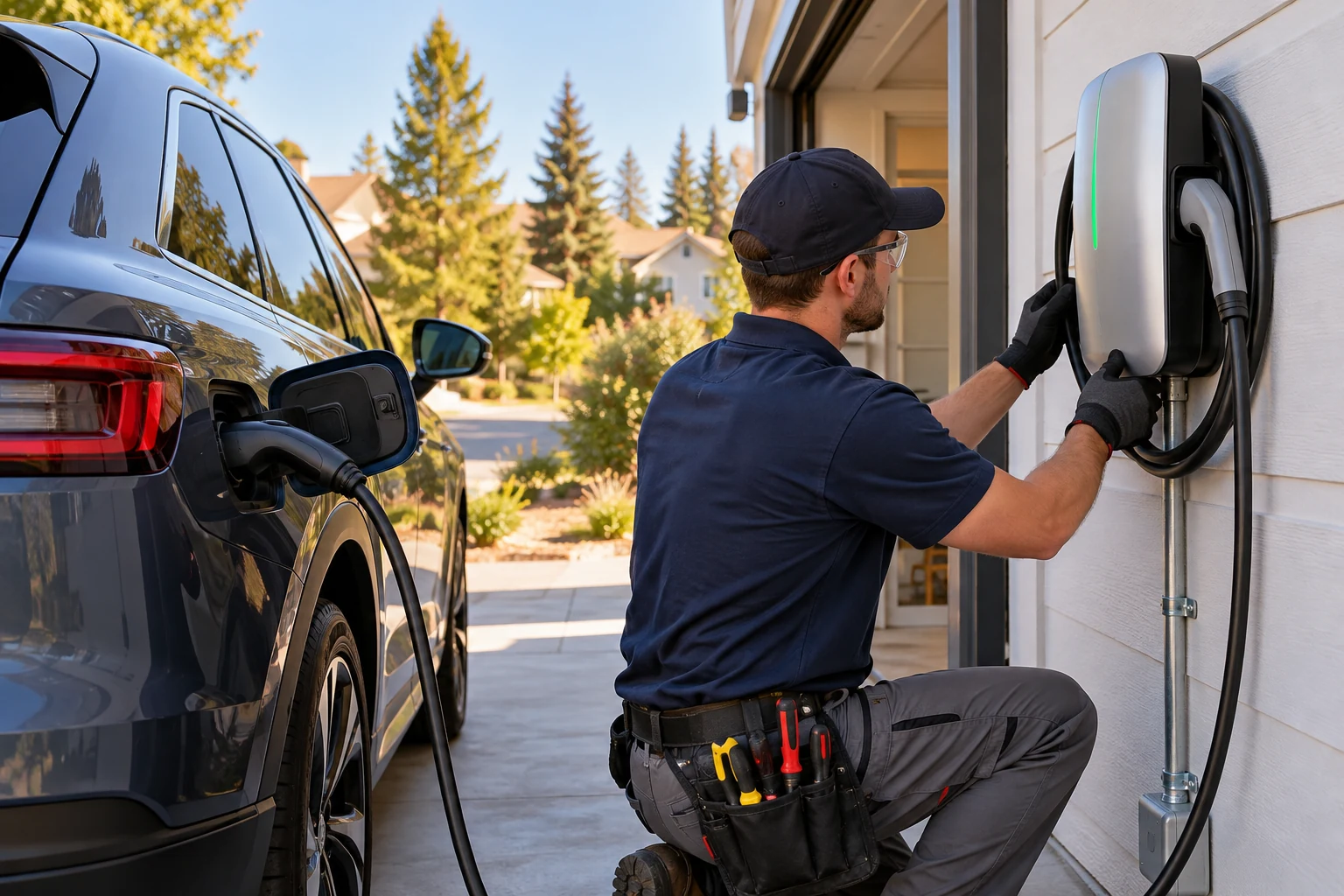
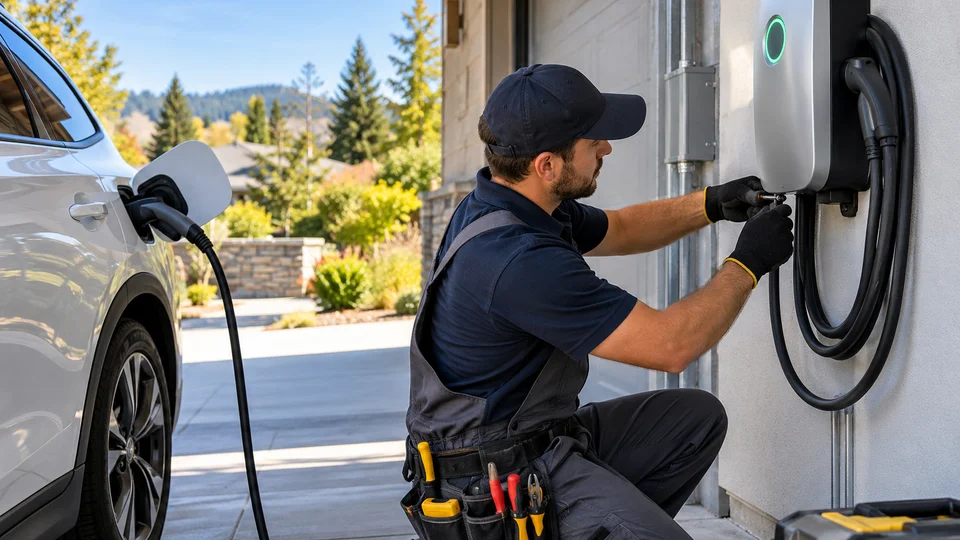
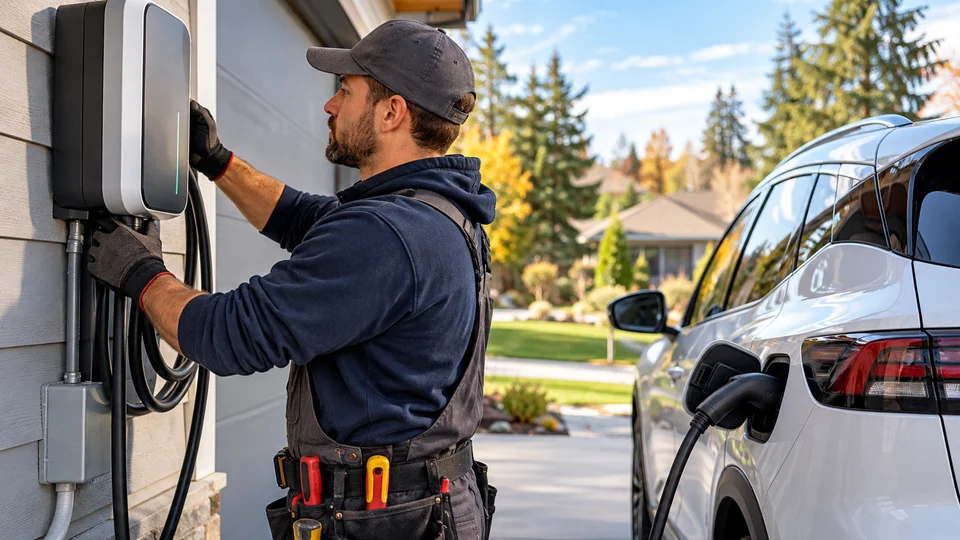
Licensed Washington electrical contractor specializing in Level 2 EVSE installations, 125A–150A panel headroom solutions, long-distance voltage drop mitigation (#4 AWG copper), and multi-EV smart charging across Indian Trail Road, Francis Avenue, and Pacific Park.
Get upfront pricing, panel load calculations, and same-week installation scheduling.
Developed primarily between 1970 and 1995, the Balboa and South Indian Trail neighborhoods feature spacious split-levels, daylight ranches, multi-car garages, and backyard workshops. While newer than central Spokane, these suburban layouts present distinct electrical challenges requiring tailored engineering.
Many Balboa / South Indian Trail homes were constructed with 125-amp or 150-amp electrical panels. Under NEC Article 625.42, an EV charger is legally classified as a continuous load, requiring a 125% safety multiplier. A 48A charger draws 48 amps continuously, demanding a dedicated 60-amp two-pole breaker.
When a 125A or 150A panel already supports a central air conditioner (20–30A), electric dryer (24A), electric water heater (18.8A), and kitchen appliance circuits, adding a 60A continuous load creates an immediate violation under NEC Article 220. Operating these appliances concurrently risks thermal main breaker tripping or utility drop degradation.
In Balboa and South Indian Trail daylight basement ranches, the main electrical panel is often situated in the rear basement utility room, while the garage is located at the front of the home on the upper grade. These 70 to 120-foot wire runs create significant electrical resistance.
The National Electrical Code recommends under NEC Section 210.19(A) that total voltage drop on branch circuits should never exceed 3% for safe and efficient operation.
If an installer pulls standard #6 AWG copper wire over a 100-foot run supplying a continuous 48-amp charger, voltage drops from 240V down to 231V (a 3.8% loss). This voltage sag causes the EVSE to throttle charging speed, generates excessive heat in conduit passages, and wastes electricity.
Expansive parcels in South Indian Trail frequently include detached workshops, heated hobby garages, or 50-amp RV parking pads. Powering high-draw EVSE in these auxiliary structures requires compliance with strict outbuilding electrical codes.
| Circuit Run Distance | Recommended Conductor Gauge | Max Continuous Draw | Calculated Voltage Drop | Recommended Application |
|---|---|---|---|---|
| 0 to 50 Feet | #6 AWG THHN Copper | 48 Amps (60A Breaker) | 1.1% (Minimal) | Standard attached two-car garage adjacent to panel |
| 50 to 80 Feet | #6 AWG or #4 AWG Copper | 48 Amps (60A Breaker) | 2.1% (Code Compliant) | Finished basement crossover to upper garage wall |
| 80 to 140 Feet | #4 AWG THHN Copper | 48 Amps (60A Breaker) | 2.4% (Optimized) | Long daylight basement run to front garage bay |
| 140+ Feet (Detached Outbuilding) | #2 AWG Cu or #1/0 Al Feeder | 60A–100A Subpanel | < 2.0% (Feeder Rated) | Backyard workshop, RV pad, or multi-EV carriage house |
Under NEC Article 225.30, residential parcels are strictly permitted only one electrical supply circuit to a detached structure. If your workshop already has a 120V lighting circuit, tapping in a second EV circuit is illegal and will fail city inspection.
We solve this by replacing existing undersized lines with a high-capacity 60A to 100A feeder supplying a dedicated garage subpanel. This subpanel powers your 48A EV charger, feeds workshop machinery, and includes two supplementary grounding electrodes (NEC 250.32) for lightning and surge protection.
With high EV adoption in Balboa and South Indian Trail, many suburban families drive two electric vehicles. Installing two independent 60-amp circuits is rarely feasible on residential panels. Here is how dynamic power sharing solves the multi-EV dilemma.
Modern Level 2 chargers—such as the Tesla Universal Wall Connector or dual-head smart EVSE—feature internal Wi-Fi communication and dynamic power sharing under NEC Article 625.42.
Both units connect to a single shared 60-amp branch circuit. When both vehicles plug in simultaneously in the evening, the system automatically allocates 24 amps to each car. When the first vehicle reaches full battery capacity, the network automatically shifts full 48-amp power to the remaining vehicle.
Perched along the high ridge above the Spokane River and Little Spokane valleys, Balboa and South Indian Trail experience harsh winter wind chill and prolonged sub-zero freezes.
When January temperatures plummet below 10°F on Indian Trail ridge, 120V Level 1 trickle chargers fail completely—consuming all 1.4 kW on internal battery heating with zero miles added. A 48A Level 2 station provides 11.5 kW, allowing scheduled battery conditioning so you maintain 100% range when driving down Indian Trail Road.
Standard PVC charger cords turn rock-hard in freezing Spokane winters, making coiling nearly impossible. We specify smart EVSE equipped with thermoplastic elastomer (TPE) charging cables engineered to stay flexible and easy to handle down to -40°F.
Avista Utilities provides up to $1,000 in rebates for ENERGY STAR certified Level 2 smart EV chargers installed by licensed contractors. Recharging off-peak between 11 PM and 6 AM costs approximately $9.50 for a full 75 kWh battery—equivalent to paying $1.15 per gallon for gas.
As an authorized Avista Trade Ally partner, Spokane EV Charging Specialists streamlines the entire rebate application process. We verify that your selected charger is on the Avista qualified products list, itemize labor and materials, attach municipal inspection Green Tags, and provide turnkey rebate filing assistance.
Most Balboa and South Indian Trail homeowners receive their rebate check within 4 to 6 weeks, dramatically reducing their out-of-pocket investment.
From precise load calculations to final municipal green tag sign-offs, our licensed master electricians deliver seamless craftsmanship on every Indian Trail property.
We calculate NEC 220 panel demand, inspect daylight basement routing, and measure exact distance to calculate voltage drop.
We determine whether your address falls under City of Spokane or Spokane County L&I jurisdiction and file digital electrical permits.
We pull upsized #4 AWG copper through metallic EMT or RMC conduit, ensuring zero sagging and maximum physical protection.
Under NEC 110.14(D), we clamp all terminal lugs using calibrated digital torque tools to eliminate microscopic arcing and thermal hazards.
We configure smart amperage limits, pair Wi-Fi power-sharing networks, set up off-peak charging schedules, and test safety ground faults.
We coordinate on-site with municipal inspectors, verify the final Green Tag sign-off, and file your complete Avista rebate packet.
Under NEC Section 110.14(D), all electrical connections subject to continuous high amperage must be torqued with calibrated tools. Handymen who hand-tighten lugs risk microscopic terminal looseness that leads to melted charging ports and fires.
Our master electricians document the exact torque applied to every terminal lug, ensuring your home electrical system operates cool and safe through decades of continuous overnight EV charging.
Transparent, all-inclusive pricing with zero hidden trip fees. Eligible for up to $1,000 in Avista utility rebates and a 30% federal tax credit under IRC Section 30C.
Ideal for homes where the main electrical panel is located in or immediately adjacent to an attached garage bay.
Engineered for daylight basements requiring upsized #4 AWG copper to prevent voltage drop over 70+ ft runs.
Complete feeder line, subpanel, and EVSE installation for detached workshops, hobby barns, and RV bays.
Expert answers from licensed Washington master electricians regarding EV charger installation, voltage drop, and Avista rebates in Balboa & South Indian Trail.
📞 Call a Master ElectricianSpeak directly with our locally licensed Washington master electricians. We provide upfront quotes, handle municipal permitting across City & County jurisdictions, and guarantee maximum Avista rebate approval.